Coming Soon
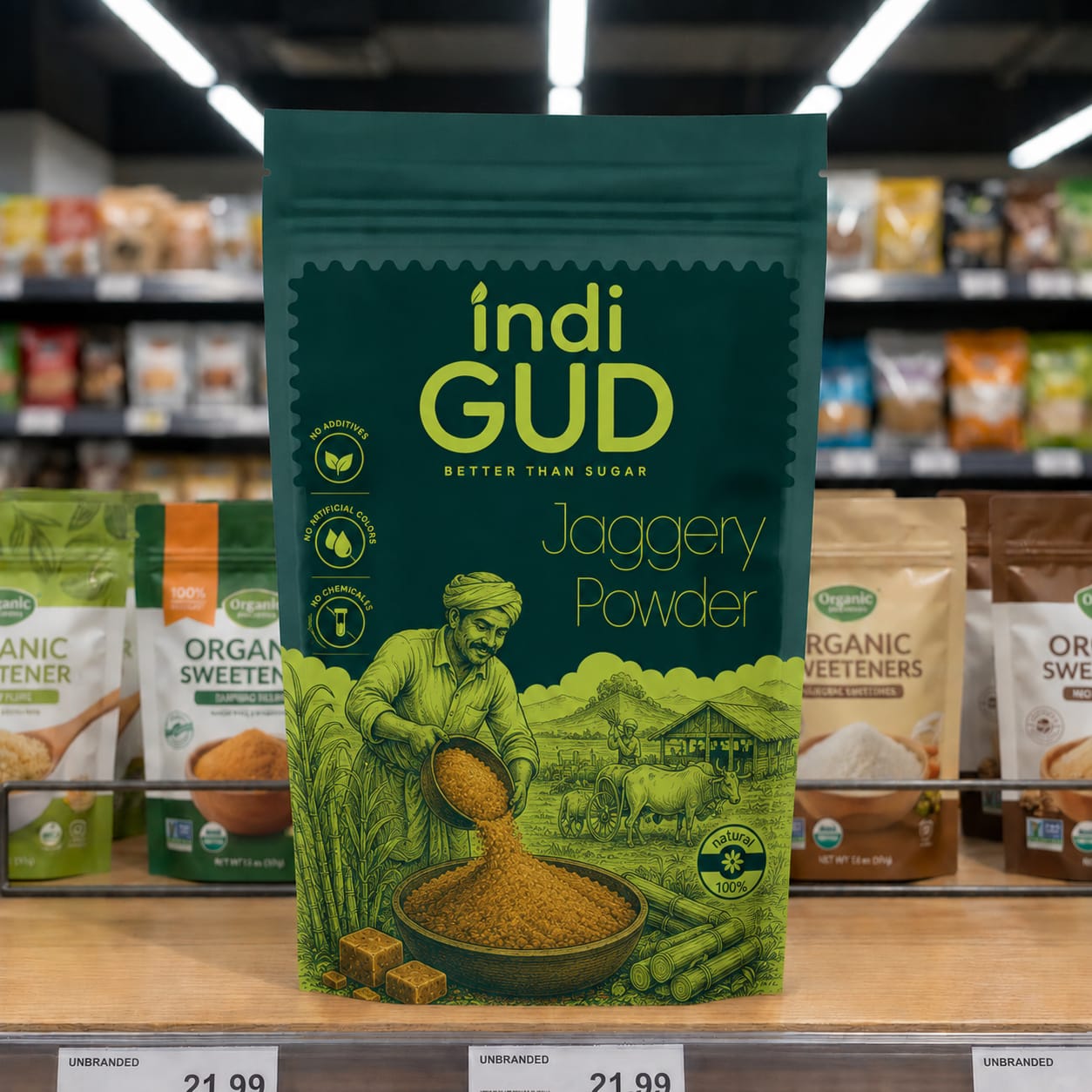
Jaggery Powder
Golden, free-flowing and ready for anything
Slow-cooked sugarcane juice, dried and stone-milled into a fine golden powder that dissolves in seconds — a spoon-for-spoon…
Open-pan jaggery (gud) from the Bijnor cane belt — clarified with okra sap instead of sulphur, reduced over wood fire, and bought direct from the families who grow it. Jaggery powder (shakkar) for your chai, gud blocks for your dal.
Both come from the same sulphur-free batches, cut from the same week's pressing. The only question is what your kitchen needs.
Coming Soon
Golden, free-flowing and ready for anything
Slow-cooked sugarcane juice, dried and stone-milled into a fine golden powder that dissolves in seconds — a spoon-for-spoon…
Coming Soon
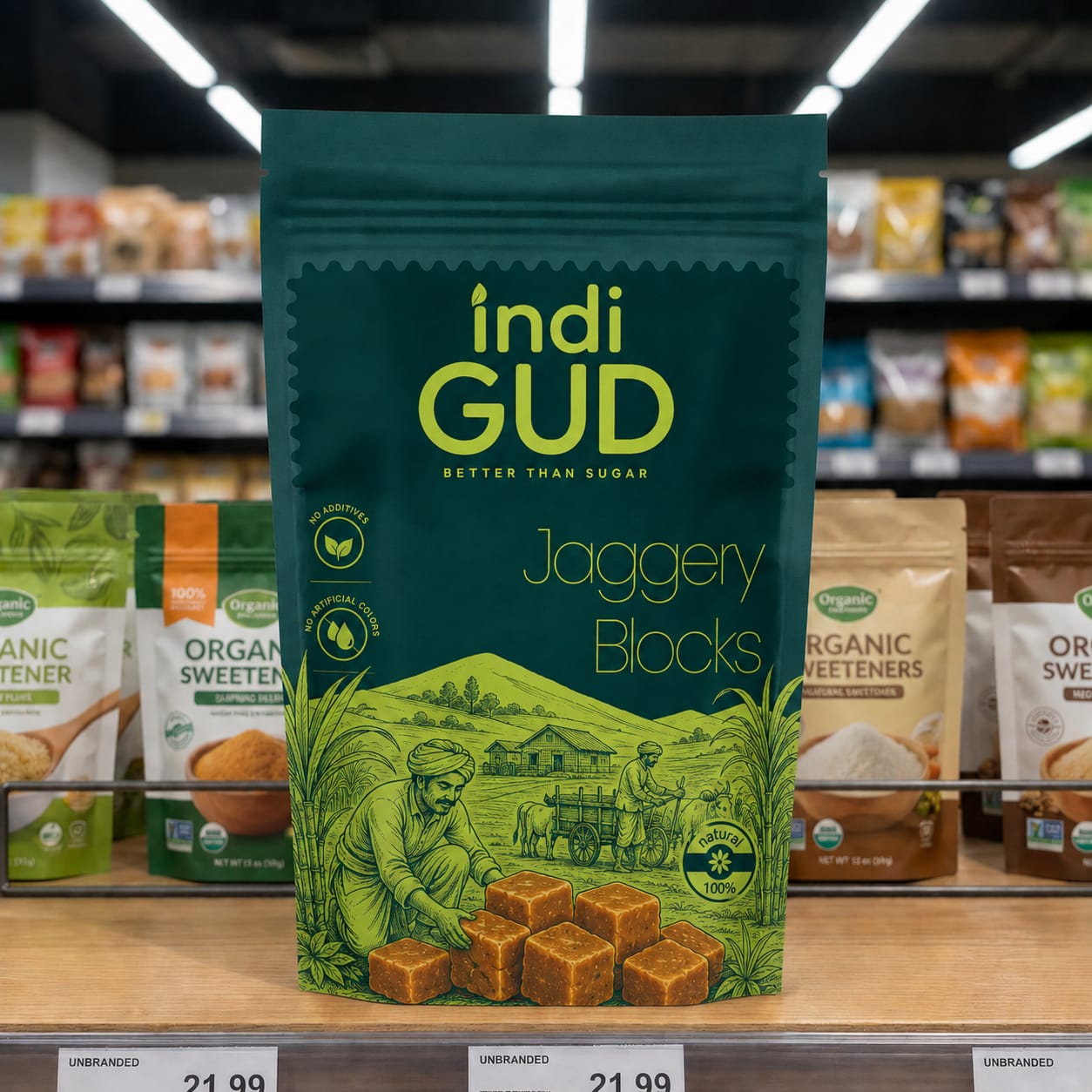
Hand-cut cubes, set the way our grandmothers did
Firm, hand-cut jaggery cubes poured into wooden moulds and cooled overnight — the traditional block, portioned for a modern…
Commodity jaggery is made fast and made pale. Neither is an accident, and both cost you something on the plate.
Refining strips sugarcane of everything but sucrose. Open-pan jaggery keeps the iron, magnesium and potassium that were there all along.
Juice is reduced over wood fire in shallow iron pans across several hours. It is slower and costlier than vacuum boiling — and it is the whole flavour.
The trade uses sulphur and hydros to force a pale colour. We use okra sap, exactly as it has been done for two centuries.
We buy from 40+ smallholder families at a premium over the mandi rate, in cash, on the day of pressing.
Roughly fourteen hours from a standing stalk to a sealed pouch. Most of it is waiting.
Cane is cut at first light between November and March, when the sucrose in the stalk peaks.
Crushed within hours of cutting. Juice that waits overnight ferments and never sets clean.
Okra sap draws the impurities to the surface. They are skimmed off by hand, three or four times.
Four hours over wood fire in a shallow iron pan until the juice darkens and thickens to a thread.
Poured into wooden moulds to cool overnight, then cut into blocks — or dried and stone-milled to powder.
Batch-coded and sealed into resealable, food-grade pouches within the same week.
Jaggery is still a sugar — we would never pretend otherwise. The difference is everything that survives alongside it.
| indiGUD Jaggery | Refined White Sugar | |
|---|---|---|
| Processing | Open-pan, wood-fired | Vacuum boiled & centrifuged |
| Clarifying agent | Okra sap | Sulphur dioxide, phosphoric acid |
| Minerals retained | Iron, magnesium, potassium | Effectively none |
| Bleaching | None | Bone char or ion-exchange resin |
| Colour | Natural amber | Chemically whitened |
| Flavour | Caramel, molasses, mineral | Flat sweetness |
I switched our entire bakery over. The crumb is softer and the caramel note does something white sugar simply cannot.
It actually dissolves. I had written off jaggery powder after three gritty brands before this one.
The blocks taste like the ones my grandmother kept in a steel dabba. That is the highest compliment I have.
Yes. Gud (गुड़, also spelt gur) is the Hindi word for jaggery — sugarcane juice boiled down until it sets, with no refining in between. indiGUD Jaggery Blocks are traditional gud, hand-cut into cubes.
Shakkar (शक्कर) is the name used across north India for jaggery that has been dried and broken down into a powder. indiGUD Jaggery Powder is shakkar: the same open-pan gud, stone-milled fine so it dissolves straight into chai, milk and batters.
Both products are in final packaging trials. Online ordering opens shortly — leave your details on the contact page and we will write to you the day it does.
Most commodity jaggery is clarified with sulphur and hydros to force a pale, uniform colour, then vacuum-boiled for speed. Ours is clarified with okra sap and reduced over wood fire in open pans. It is darker, slower and costs more to make.
It is still a sugar and should be treated as one. The difference is what comes with it: unrefined jaggery retains iron, magnesium and potassium that refining removes entirely. It is a better sugar, not a health food.
Powder for anything you stir or bake: tea, coffee, batters, marinades. Blocks for anything you simmer, grate or eat as-is: dal, laddoos, festival sweets.
Unrefined jaggery is hygroscopic — with no anti-caking agents it draws moisture from humid air. Keep it in an airtight jar somewhere cool and it stays free-flowing. Stickiness is a sign there is nothing added, not a sign of spoilage.
Colour is the quickest tell. Sulphur and hydros bleach jaggery to a pale yellow; sulphur-free gud is a deeper amber to dark brown and tastes of caramel rather than plain sweetness. Ours is clarified only with okra sap, and every pouch carries a batch code you can ask us about.
In the Bijnor sugarcane belt of western Uttar Pradesh. Cane comes from 40+ smallholder farms near Dhampur and Noorpur and is pressed, clarified and set in open pans the same day it is cut.
Yes. We supply bakeries, cafés and retailers across India. Write to indigud.business@gmail.com with your volumes and we will come back within two working days.
Gud (गुड़, often spelt gur) is what most of India calls jaggery: sugarcane juice boiled down in an open pan until it sets, with nothing taken out and nothing bleached in. Our Jaggery Blocks are exactly that — traditional desi gud, hand-cut into cubes.
Shakkar (शक्कर) is the same gud, dried and broken down into a loose powder. That is our Jaggery Powder: stone-milled fine enough to dissolve in chai, warm milk and cake batter like ordinary sugar.
Whichever word you use, look for one thing on the label: sulphur-free. Pale, lemon-yellow gud has usually been whitened with sulphur and hydros. Proper jaggery is amber to dark brown, and tastes of caramel rather than plain sweetness.
Online ordering opens shortly. Send us a note and we will write to you the day the first batch goes live.