Why is some jaggery pale and some dark?
Cane juice carries impurities that have to be lifted out before it sets. The traditional
way is a plant clarifier — usually the mucilage of okra or wild bhindi — that binds the
impurities into a scum which is skimmed off by hand. It works, but it leaves the jaggery a
natural amber to dark brown.
Dark gud sells more slowly than light gud, so much of the market jaggery is whitened with
sulphur dioxide and sodium hydrosulphite ("hydros"). The
result is pale, uniform and flatter in flavour, and it can carry sulphite residues.
How to spot sulphur-free jaggery
-
Colour: amber, golden-brown or dark brown. A bright lemon-yellow block is
the clearest sign of chemical clarification.
-
Taste: caramel, molasses and a faint saltiness. Sulphured gud tastes of
plain sweetness, sometimes with a sharp aftertaste.
-
Texture: slightly sticky in humid weather. Real jaggery has no
anti-caking agent, so it draws moisture from the air.
-
Label: look for "sulphur-free" or "chemical-free" and a named origin.
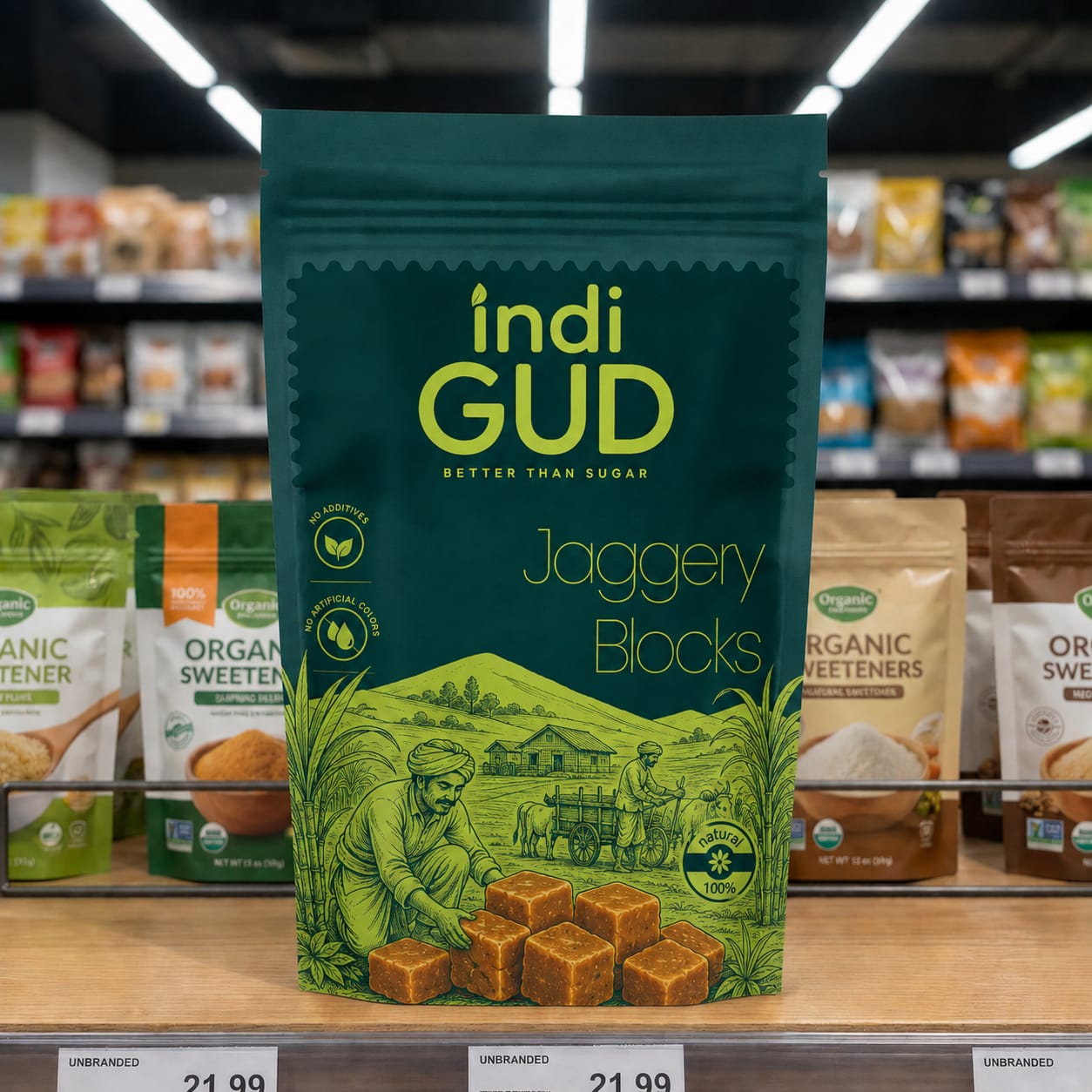
indiGUD is made in the Bijnor cane belt of Uttar Pradesh and every pouch carries a batch
code.
Is jaggery healthier than sugar?
Jaggery is still a sugar, and it has roughly the same calories as white sugar spoon for
spoon. What it adds is everything refining takes away: small amounts of iron, magnesium and
potassium, and a fuller flavour that often means you use less. It is a better sugar, not a
health food — and anyone managing diabetes should treat it exactly like sugar.
How to use gud and shakkar
- Stir a teaspoon of shakkar into chai or filter coffee instead of sugar.
- Swap jaggery powder 1:1 for white sugar in cakes, cookies and pancakes.
- Drop a cube of gud into dal, sambar or rasam while it simmers.
- Melt gud with ghee for til laddoos, chikki and gajak in winter.
- Break off a small piece after a meal, the way it has always been eaten in India.
How to store jaggery
Keep gud and shakkar in an airtight jar in a cool, dry cupboard, away from the stove. In the
monsoon, a jar with a tight lid is the difference between free-flowing powder and a single
lump. If it does clump, it has not spoiled — break it up or warm it gently. Stored well,
jaggery powder keeps for about a year and blocks for longer.
 Coming Soon